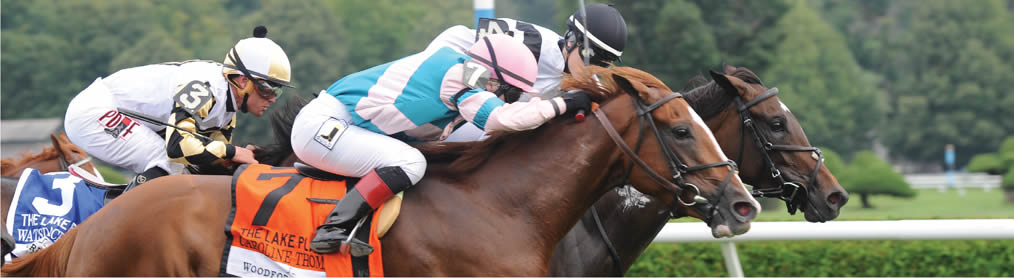
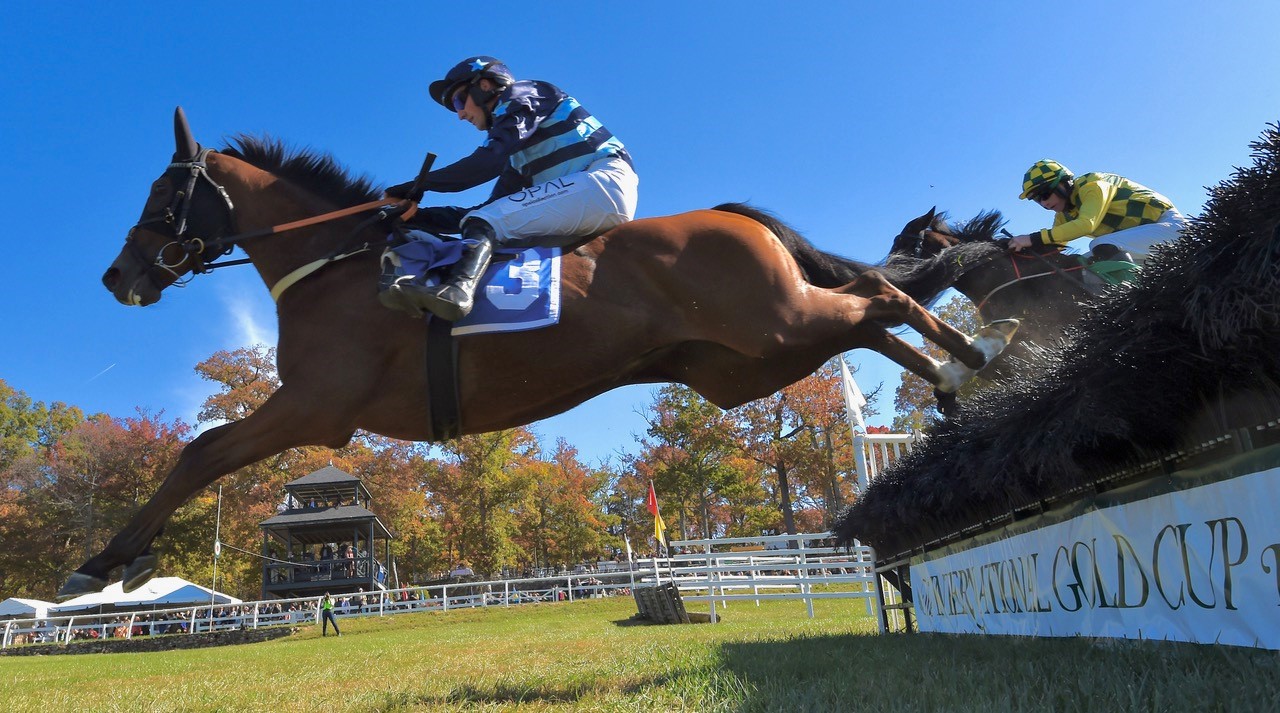
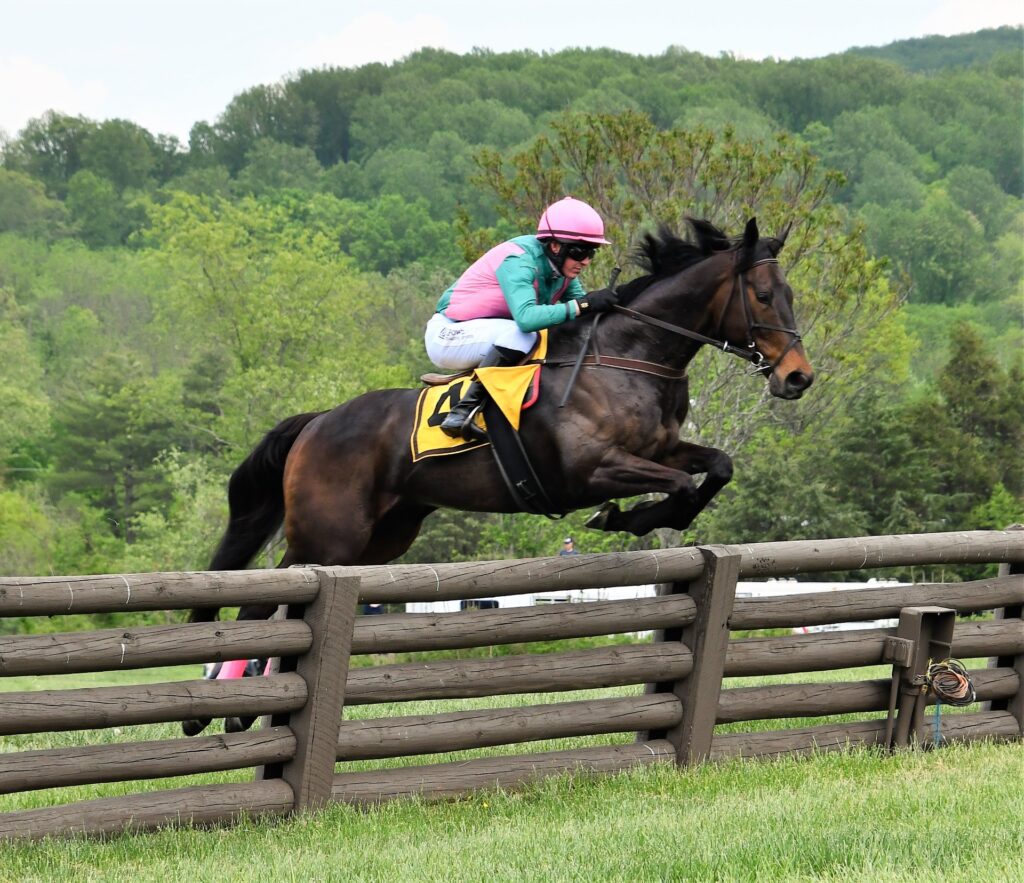
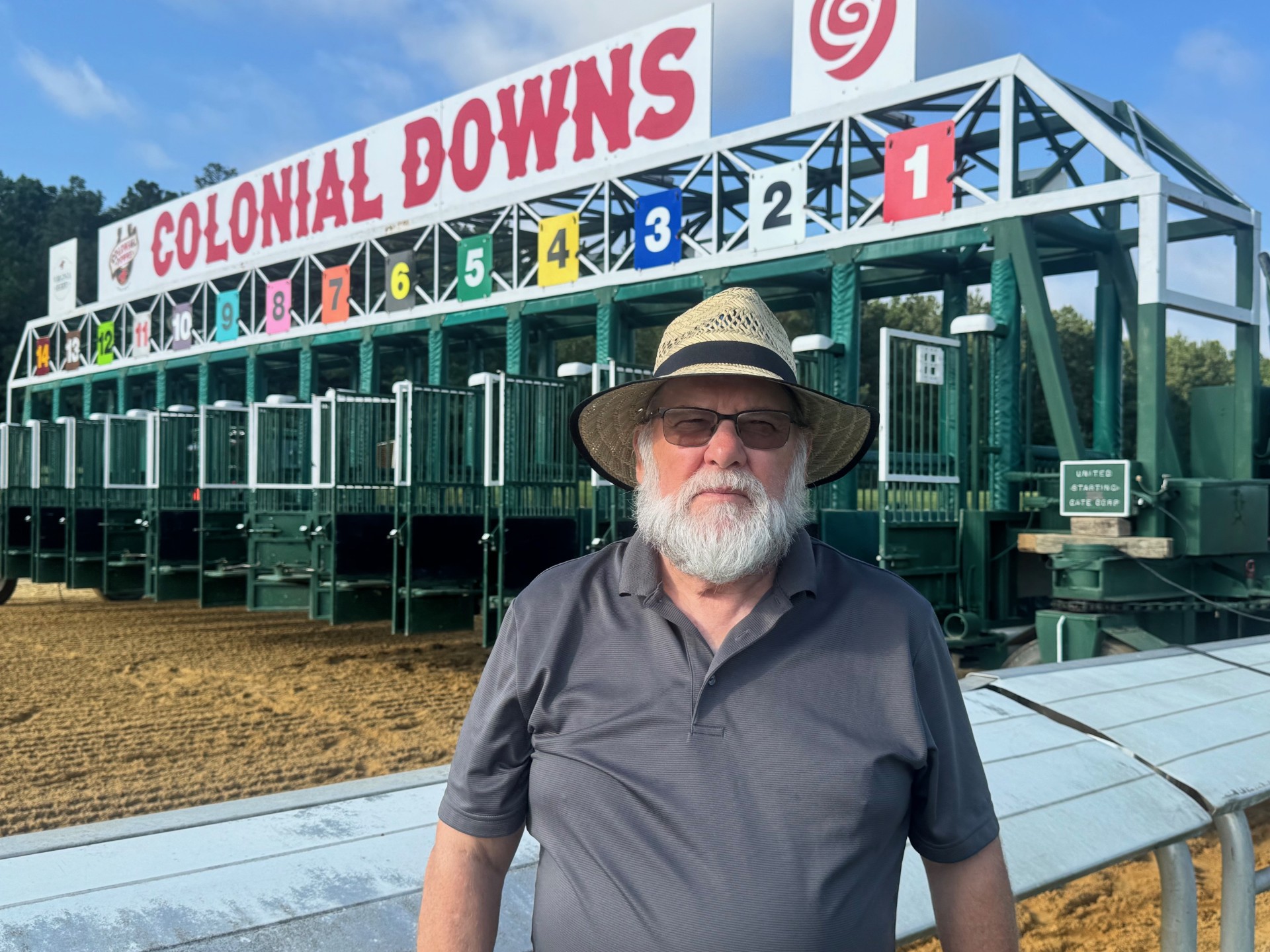
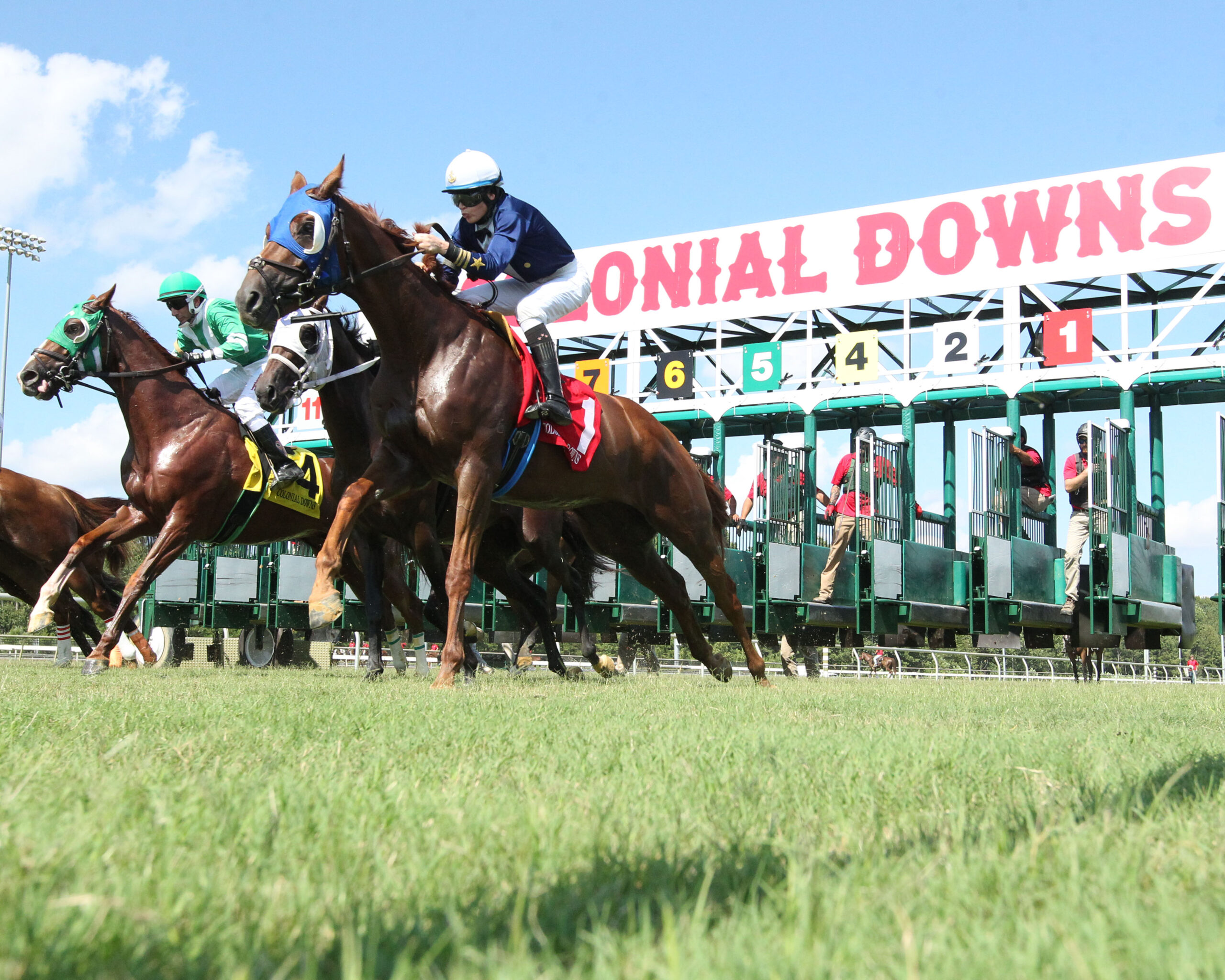
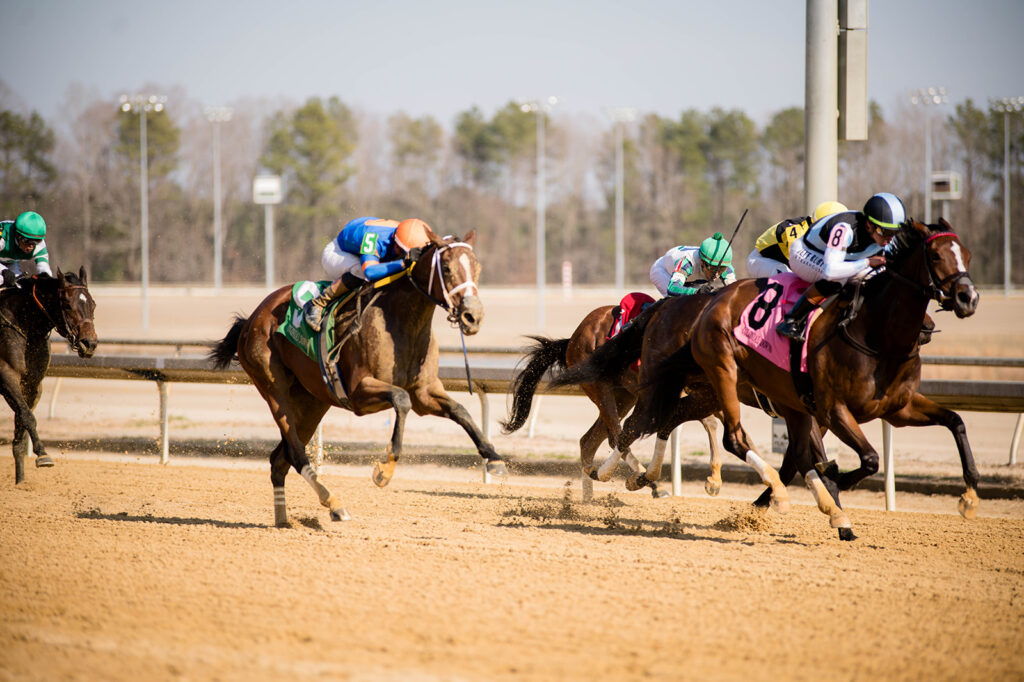
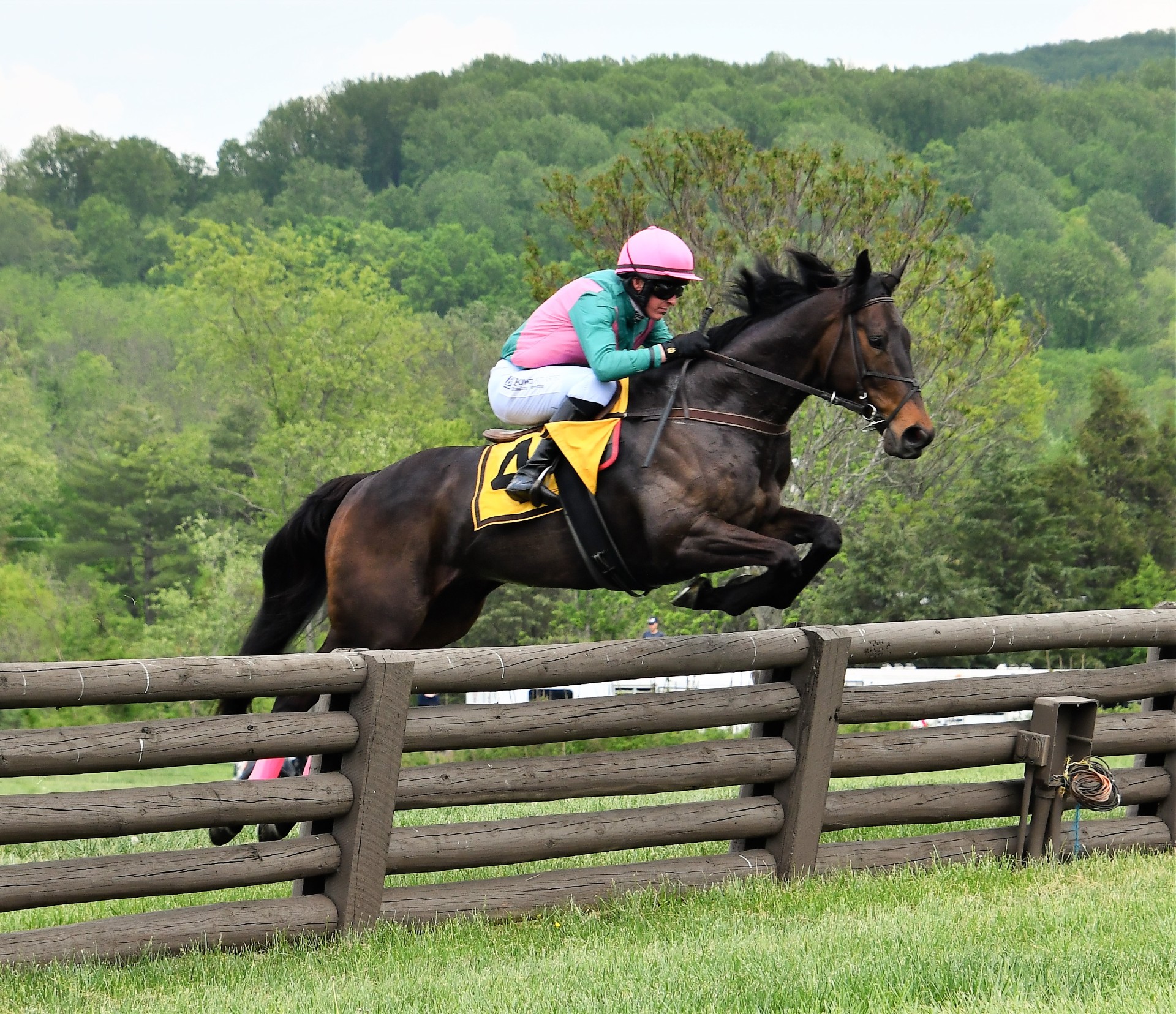
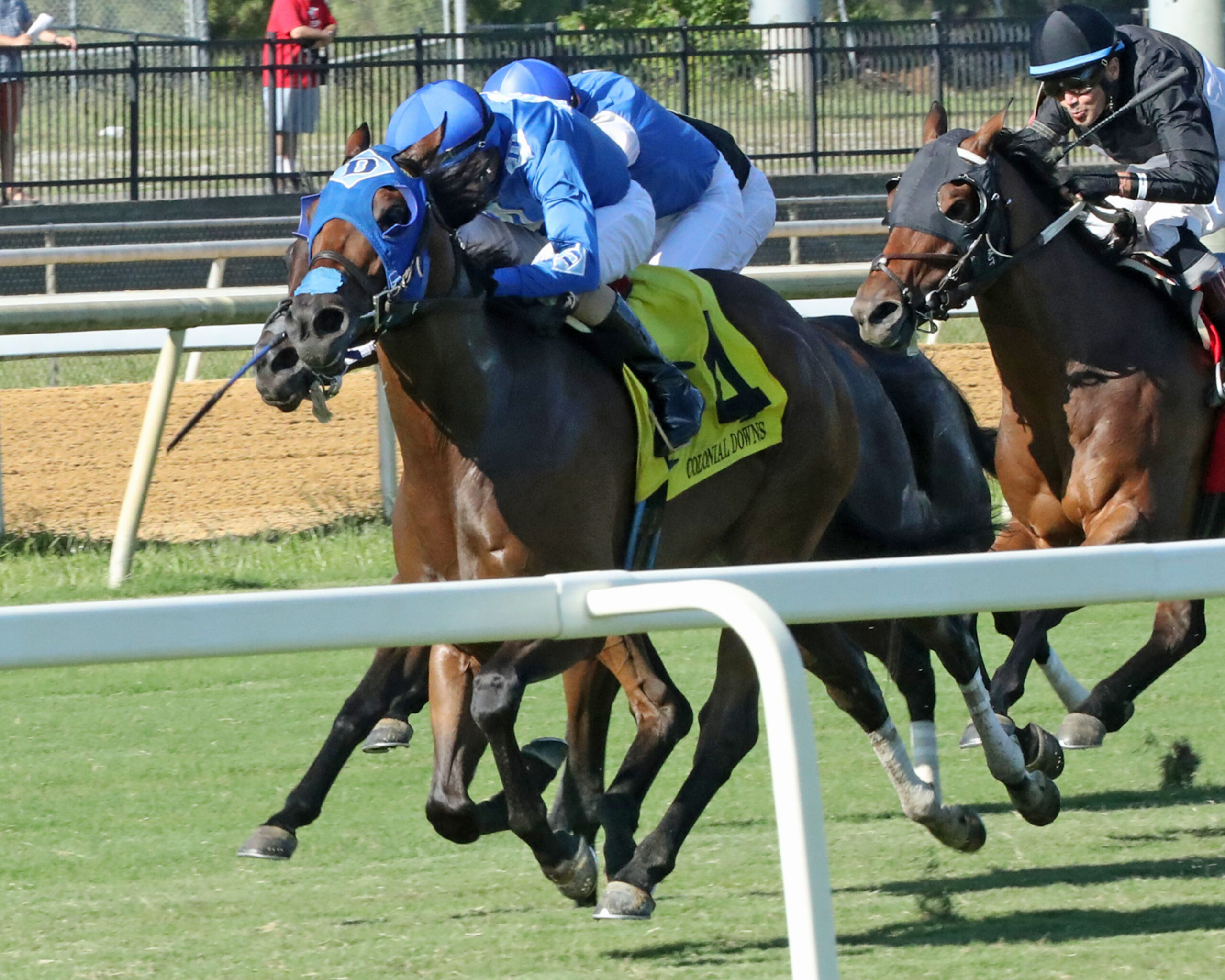
Thoroughbred horse trainer Woodberry Payne’s lifelong interest in steeplechase racing — as a trainer initially — led him to switch gears 17 years ago and attend stewards school at the request of the National Steeplechase Association (NSA). He embraced the coursework, got certified and from that point, gave up training jumpers and became a racing official instead. That’s why he is so excited about this Thursday’s (July 10) opening week card at Colonial Downs — which features a trio of jump races beginning at 10:45 AM. Purses range from between $40,000 – $60,000 and all the races will be available to wager at the track and via simulcast.
“The purse structure is top level especially with maiden races at a $60,000 level,” he said. “The first three races all filled and the maidens overfilled. It has created interest and enthusiasm. Combine that with the great stakes program for fillies and it fills a certain spot in the market that Colonial holds uniquely, just like the Turf Festival that includes the Arlington Million and the spring Virginia Derby card.”
As the summer thoroughbred meet in New Kent continues, six other Thursday jump days are scheduled. In all, there will be 18 NSA races over jumps, one flat race featuring jumpers — which was very popular last year — and a pair of $100,000 steeplechase stakes for fillies & mares.
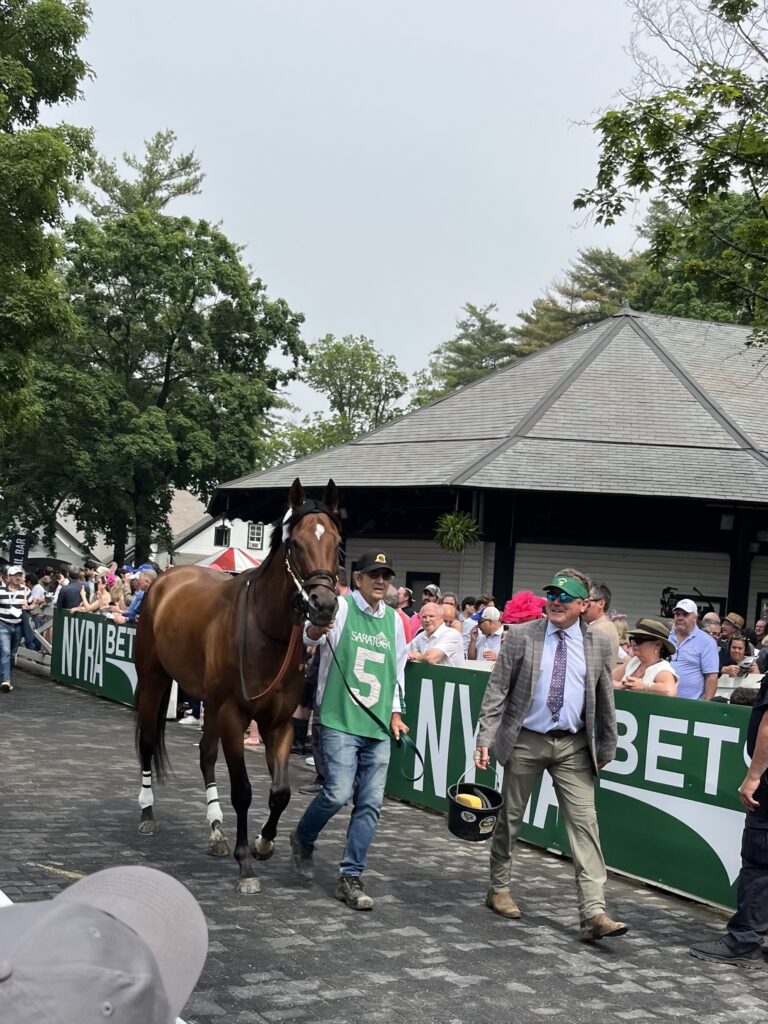
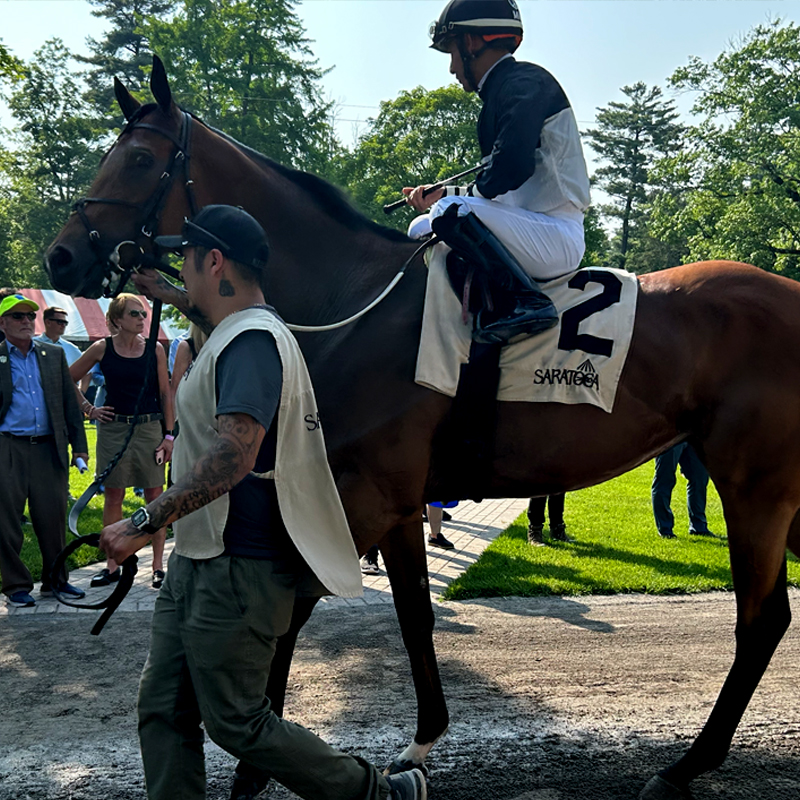
“We’ve got a great program going,” said Payne. “We’re complementing the Saratoga program which has six races and meshes together with ours nicely to create a very productive summer. The Colonial races now provide a near year-round steeplechase program in Virginia. Previously, a trainer had a hard time making it work because things shut down over summer.”
This time of year, Payne’s schedule can get quite hectic. In addition to running his 80-horse Ingleside Training Center in Montpelier Station — where many of his New York & New Jersey clients ship babies in to become Virginia-Certified — he has a 12-horse stable at Rosie’s Gaming and Colonial Downs, travels to Saratoga to work their Wednesday jump race, then takes a flight back to Richmond in time for Colonial’s Thursday morning jump races.
“It keeps my itinerary full,” he said. “I feel like I live in a triangle sometimes between the farm — which is a 90-minute drive from Colonial, the track itself in New Kent, then Saratoga. I make a living by training flat horses. The Virginia Certified residency program has benefitted us all. I’m getting calls from New York clients to run their horses here now. But I have a love of jumpers too — I’ve been around them in some form my whole life. They are two different worlds but I’m equally attached to both.”
Payne is optimistic about the way jump racing has rebounded from Covid. “It certainly was a terrible setback to the program,” he noted. “Funding from hunt meets comes from attendance and corporate sponsorship and that has made a nice comeback. The crowds are back. It was refreshing to see the Gold Cup return to where they used to be this past May with thousands of fans in attendance.”
Welcome back! Colonial Downs’ 41-day summer meet will run July 9-September 13. Race Days are as follows: · Wednesdays-Saturdays · Saturday, August 9th Festival of Racing · Monday, September 1st (Labor Day) · Saturday, September 6th GIII Old Dominion Derby / Old Dominion Oaks
2025 VIRGINIA YEARLING FUTURITY Sunday, August 24, 2025 · Warrenton Horse Show Grounds
Join us at the Warrenton Horse Show Grounds at 9:00am on August 24th. Show off your, registered, Virginia-Bred, Virginia-Sired, or Virginia-Certified thoroughbred yearlings. $40,000 in cash prizes will be divided up between each class.
“Please join us as we open the summer meet at Colonial Downs on July 9th. We’re so excited to put on a meet that consists of 41 race days through September 13th. Bring the family and friends for fun at the track. Thoroughbred racing in the Commonwealth is back and better than ever! Hope to see you there.” –Turner Kobayashi, President of the VTA Board
Virginia Horsemen’s Benevolent & Protective Association
Things are ramping up quickly at Colonial Downs as the backstretch officially opened on June 23, welcoming horses and horsemen in preparation for Opening Day on July 9.
The VHBPA is pleased to announce that its General Membership Meeting will be held at noon on Friday, July 11, at the VHBPA Office. This is a great opportunity for horsemen to connect with their VHBPA representatives, discuss the upcoming meet, and share any thoughts or concerns. BBQ lunch will be provided by Richmond’s own ZZQ Barbeque.
Mark your calendars for the VHBPA’s annual Shannon Campbell and Permanently Disabled Jockey Fund (PDJF) Golf Tournament, taking place on Sunday, August 10 at Brookwood Golf Club in Quinton, VA. To register a team or become a sponsor, please email aidanturnagebarney@virginiaequinealliance.com.
For any questions regarding the VHBPA or the 2025 Colonial Downs meet, contact:
We are looking forward to upcoming Steeplchase racing at Colonial Donws and our Virginia fall meets
July 9-September 13 Thursdays @ Colonial Downs. First post is 10:45am. October 5 – Foxfield Fall Races October 11 – Virginia Fall Races October 25 – International Gold cup November 1 – Montpelier Hunt Races
Coming off the successful spring meet, everyone is excited for the fall meet. Conveniently located at the Shenandoah County Fairgrounds (I-81, Exit 283) there is racing every Saturday and Sunday with Pari-mutuel wagering on all races.
Race days are as follows: · Saturday-Sunday Sept 13-Oct 26 · Click here to view post times
Reminders Thoroughbred Owners, Breeders, and Participating Facilities
MARES IN-FOAL · SEPTEMBER 1 DEADLINE
Breeders of Virginia-breds earn bonuses for finishing 1st, 2nd, 3rd ANYWHERE in North America.
To qualify—your mare must be in Virginia by September 1st and reside there until she foals next spring. Mare reports are due by October 1st
Get your Thoroughbreds foaled in Virginia registered with the VTA
Virginia Thoroughbred owners, don’t forget to register your Virignia-foaled thoroughbreds! Prompt registration with the VTA is crucial for your horse to be recognized as a Virginia-bred, unlocking eligibility for lucrative restricted races and breeder incentives. Click below to complete the registrations process and ensure your Virginia-bred can reap all the benefits
Can my 2-year-old reside at Colonial Downs during their 6-month VA residency to be VA-Certified?
YES, Colonial Downs is an approved VA participating facility. Keep in mind, the horse must arrive by June 30th. *Applications and fees are due by July 31st.
Please note the following: 1. The horse will not be eligible for Virginia Restricted races until they have completed all requirements of the program. 2. The developer will not be eligible for any Virginia-certified awards until the horse is fully registered Virginia-certified. 3. When filling out the application, please put “Colonial Downs” as the facility & notify the VTA via email the name of the Trainer the horse is stabled with. 4. The horse may not leave the state of Virginia during the 6-month residency period. 5. At the end of the summer meet, the horse will need to move to a Virginia participating facility registered with the VTA if they have not completed their 180-day residency.
The 100th running of the Virginia Gold Cup at Great Meadow Race Course saw strong fan attendance despite threatening weather. Highlights included Cool Jet’s first ever Grade 1 victory in the Commonwealth Cup and Keys Discount securing his second consecutive stakes win with the Virginia Gold Cup timber stakes. Mission North dominated the Speedy Smithwick, while Fashion Line reaffirmed his prowess in the steeplethon. Additionally, The Wizards Well achieved his first career win, and Active Duty claimed victory in an allowance race.
Virginia Represented at the Belmont Racing Festival
Virginia had a strong presence at the Belmont Racing Festival through successful Virginia-certified horses. Bernietakescharge and Book’em Danno achieved wins in various stakes races, while Future Is Now placed second in a Grade 2 race. The Virginia Thoroughbred Association is excited for these horses and their connections, underscoring the growing success of Virginia-certified talent in major racing events.
The spring season was highlighted by a slate of Virginia Breeder’s Fund 3-year-old divisional championships for pacers and trotters of both sexes who competed for a combined $354,500 on closing weekend. Breeder’s races for 2-year-olds, along with an inaugural slate of Sire Stakes races for freshmen, will be sprinkled in throughout the fall calendar.
There were many spring meet highlights authored by participating Virginians. Jane Dunavant’s (Kenbridge, VA) Kat’s Fancy set a new track record in the $89,600 Virginia Breeder’s 3-Year-Old Filly Trot Championship (1:56 1/5). Tracy Bradshaw’s (Bland, VA) Joan Deer earned “Horse of the Meet” honors by collecting three wins, three seconds and a third in seven starts. Chuck Perry’s (Suffolk, VA) consistent 12-year-old pacer John’s Dream continued to thrive, collecting his 29th win at Shenandoah Downs making him the winningest horse ever at the Woodstock oval.
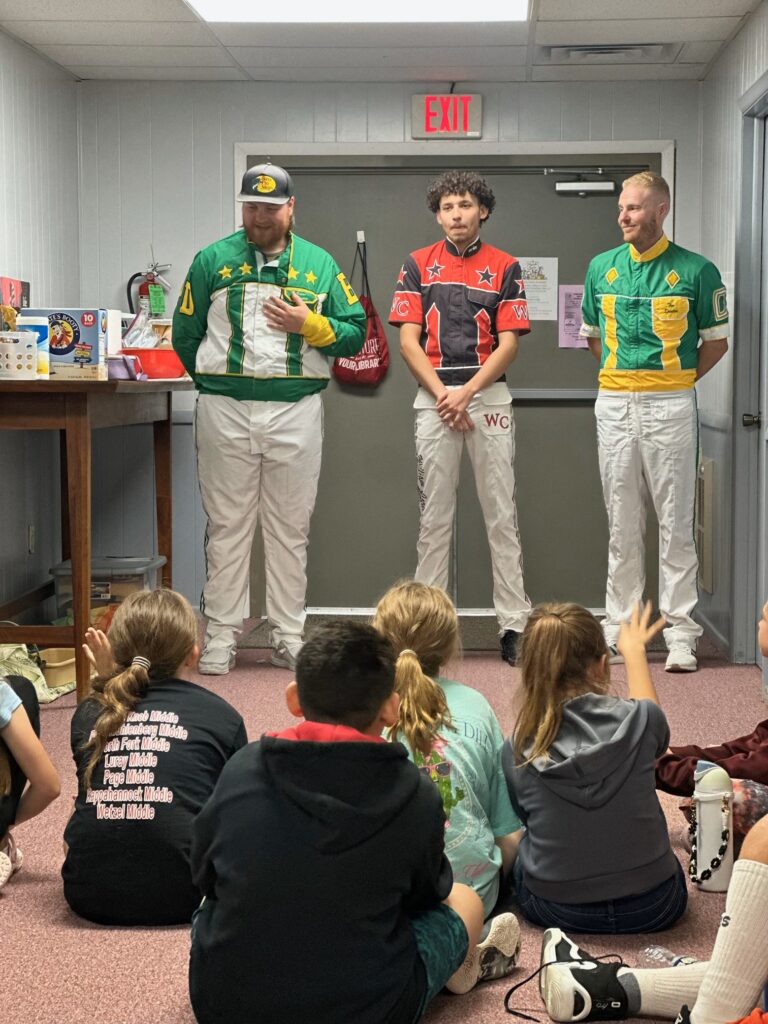
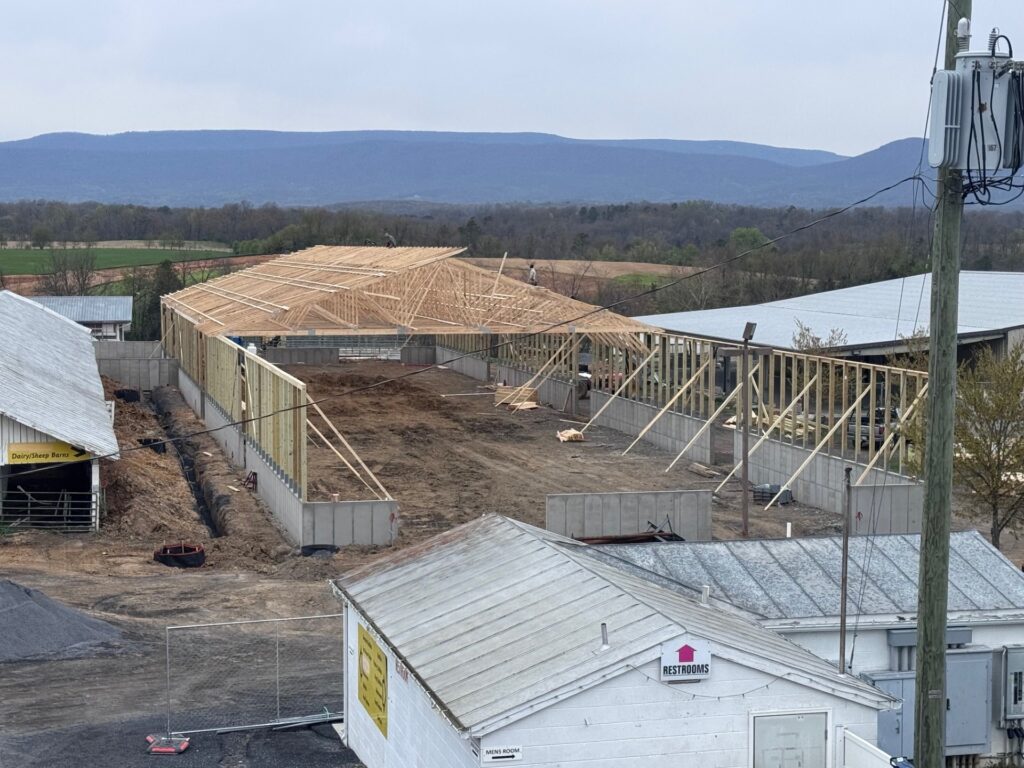
Shenandoah Downs will usher in a new era of racing this fall when a massive new $1.8 million barn will make its debut and accommodate all the horses that stable on the grounds throughout the meet. The major portion of the stabling area — which has been under tent canopies with temporary stalls for the last 10 years — was taken down for the final time June 11.
Industry Related News
More Opportunities for VA-Bred/Sired & VA-Certified
April 9th the Maryland Commission approved a proposal to combine VA & MD bred stakes through March 2026.
In addition to the added stakes program, Virginia-Restricted purses at Colonial Downs are 25% higher than open races.
Six VA-bred/sired and MD-bred/sired stakes. Eligibility: VA-bred/sired and MD-bred/sired.
Four VA-bred/sired stakes. Eligibility: VA-bred/sired. VA-Restricted races including overnight handicaps & stakes.Eligibility: VA-bred/sired, & VA-certified
Click on the buttons below to read more on what the meet has to offer.
We are saddened by the news of Trainer D. Wayne Lukas’ passing, announced only one week after the press release that he would be taking a step back from training. Tributes from all over the country flood the internet calling him, “The greatest of all time.”
Joe Nevills—Paulick Report bloodstock editor—shares his insights on the racing industry in North America and the upward trend racing in Virginia is making.
Meet new Colonial Downs Seasonal Dirt Track Superintendent Roy Smith — who was coaxed of retirement after he and his wife relocated to Providence Forge, VA — of all places ironically — from Indiana. Yes, that Providence Forge which is just four miles down the road from Colonial Downs. “The world works in strange ways,” Smith said.
Smith, whose father was a trainer, was born in Massachusetts but didn’t want to train horses. After befriending the track superintendent at Suffolk Downs, Smith was hired as his assistant and after he passed, took over that job. Three years later, he took the track superintendent’s job at Philadelphia Park where he spent 31 years, then finished his career at Indiana Grand for the final ten.
“I’ve been blessed my whole life just to be in this industry, 46 or 47 years now,” he said. “My wife and I often vacationed in Williamsburg and always enjoyed it so when it came time to retire, we looked for a place there and other neighboring areas but always got outbid. This went on for 1 1/2 years. My wife finally saw this property in Providence Forge, came out, looked at and bought it. We moved in late February and someone told Frank Hopf (Colonial Downs Sr. Director of Racing Operations) I was here. He ended up calling me three weeks later. News travels fast,” he added.
“After Frank Hopf called and offered me the job, I no sooner hung up the phone and my wife said ‘take the job, take the job’ — she didn’t care if I went back to work. I missed it in retirement and am glad to be here.”
Smith’s mentor was Joe King who built Indiana Grand and together with John Passero, built Colonial in the mid 90’s. “It feels good to be here,” he said. “Anytime I got an opportunity, I’d visit a track including this one. Both track surfaces here are great. It’s a gorgeous place and a beautiful plant.”
The 10-week, 41-day summer season in New Kent begins July 9 and continues thru September 13. Post time every Wednesday, Thursday and Saturday is at 12:30 PM with Friday’s twilight cards beginning at 4 PM. A number of Thursday programs will be preceded by three steeplechase races at 10:45 AM — which will now feature pari-mutuel wagering.
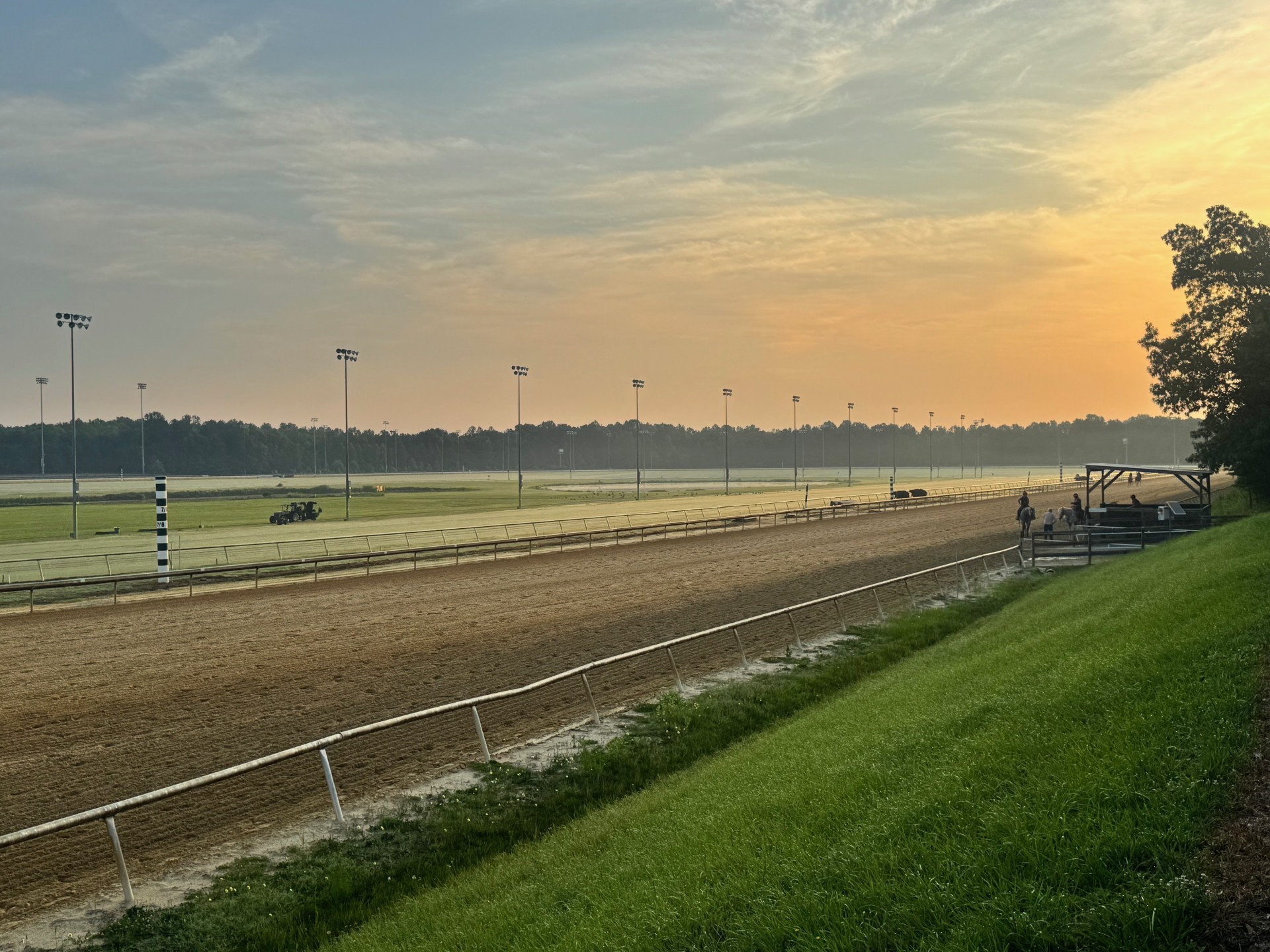
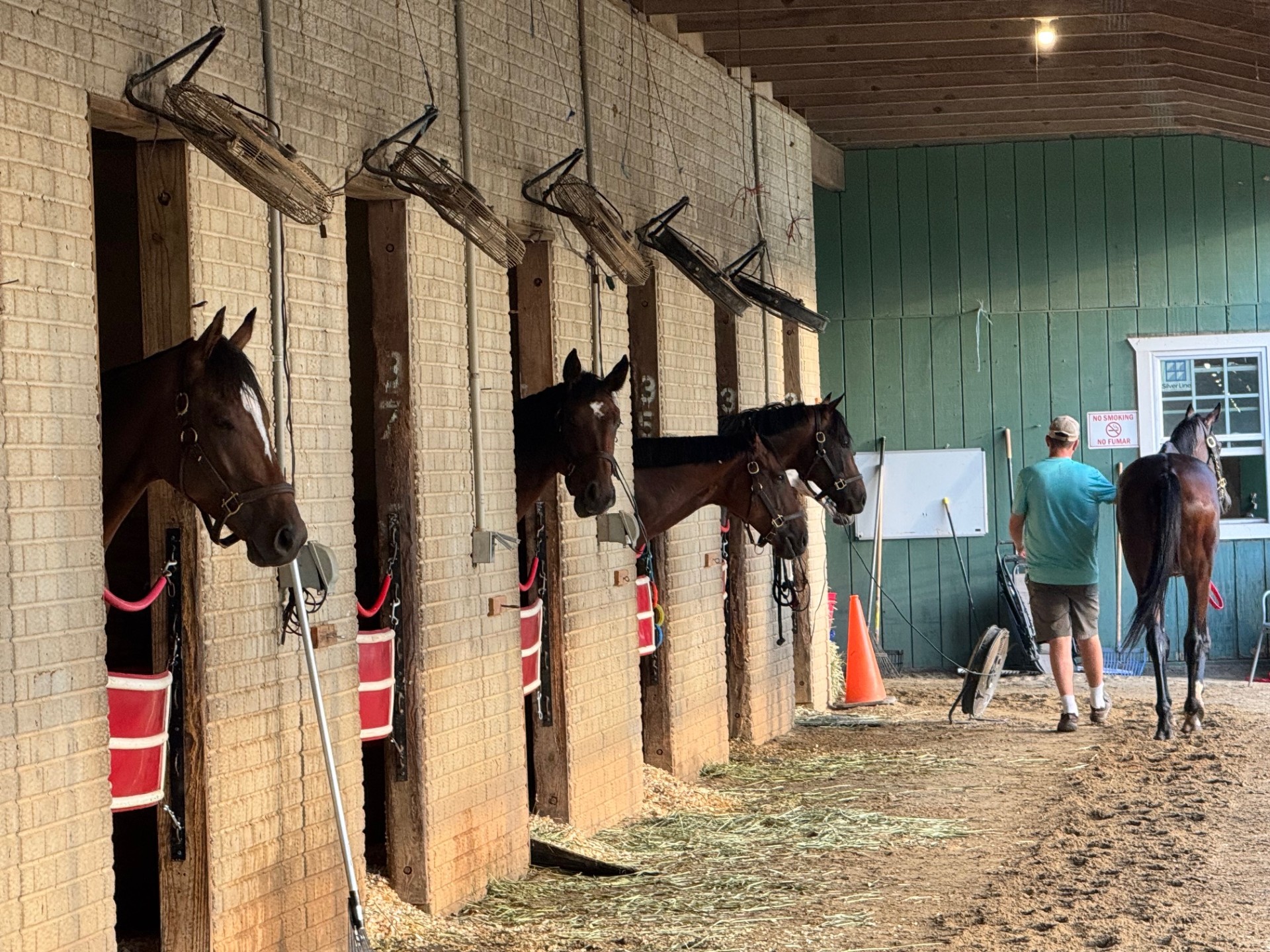
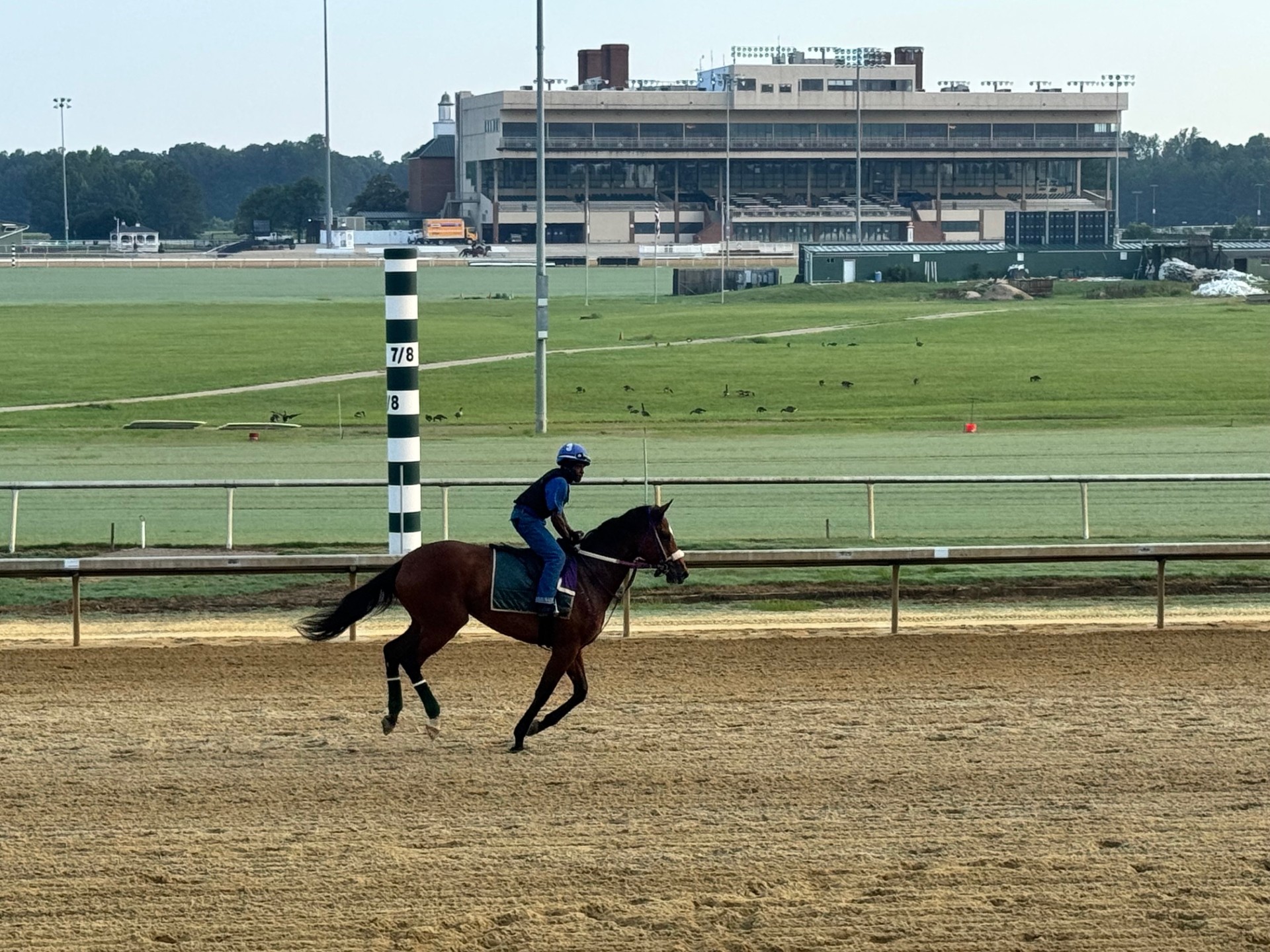
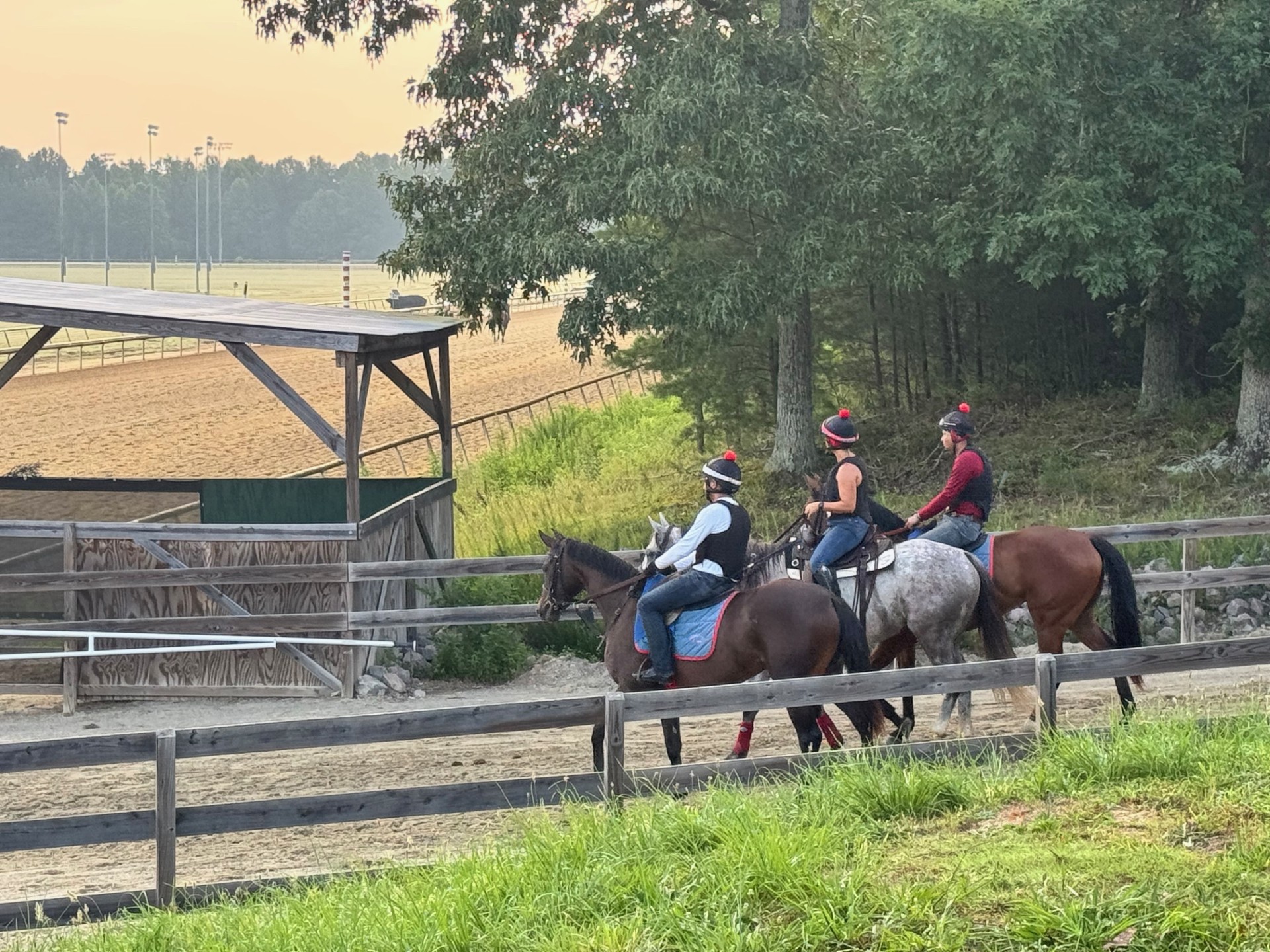
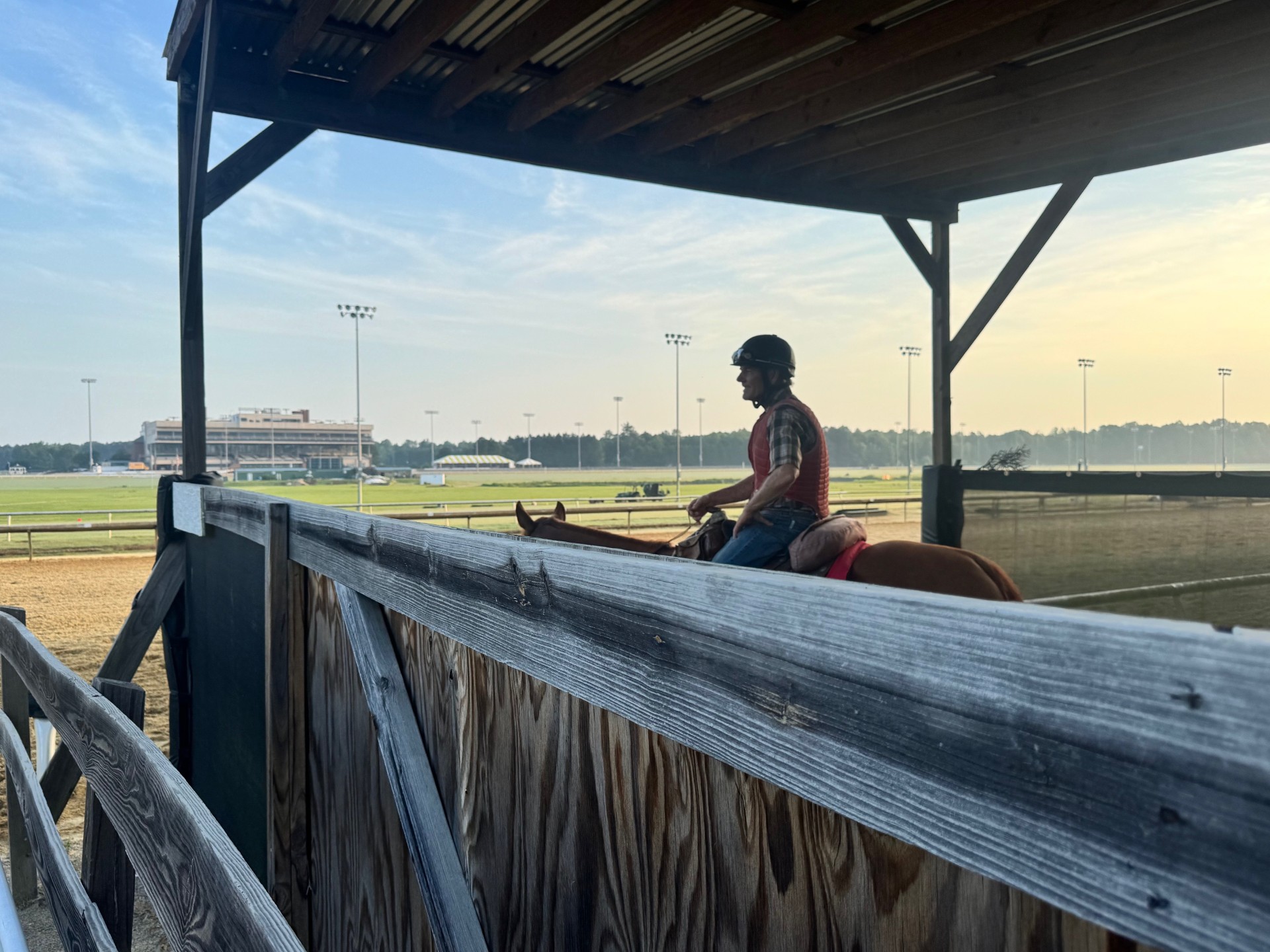
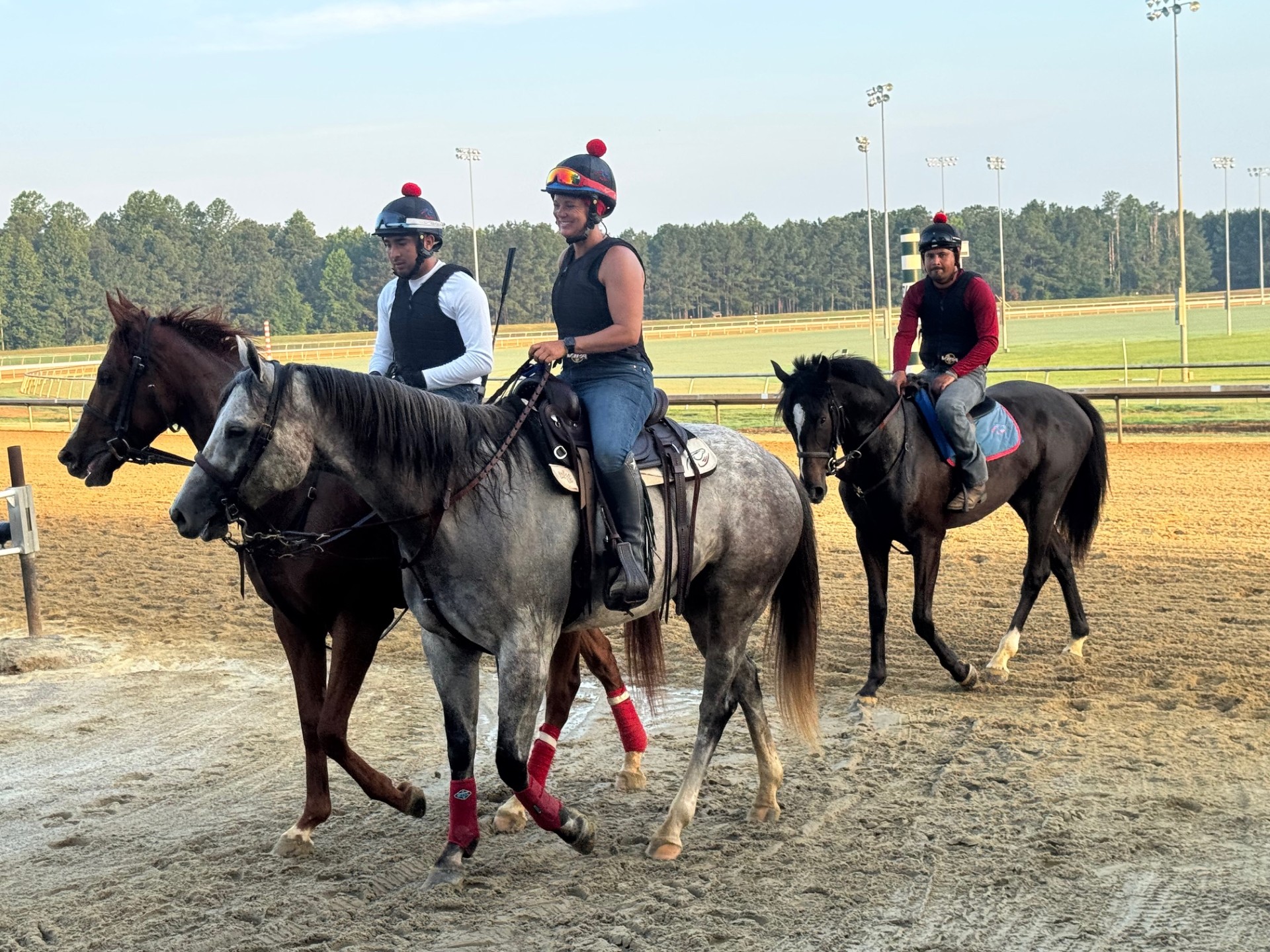
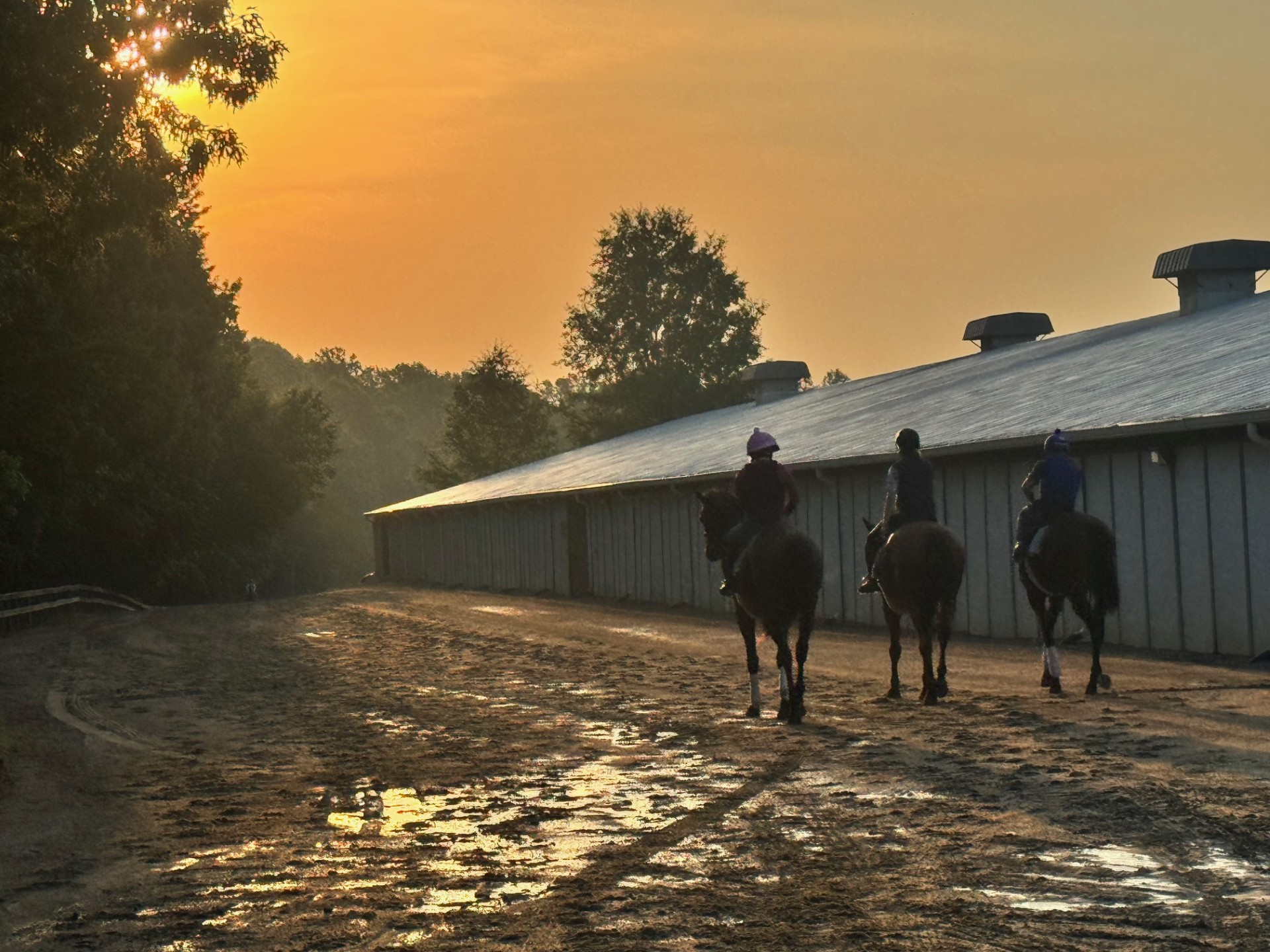
Colonial Downs opened its barn area Monday June 23 in advance of a highly anticipated 41-day thoroughbred racing season — the longest in years — that runs from July 9 – September 13. Training began on June 25 and will continue seven days a week from 5:30 – 9:30 AM.
Fans will have an opportunity to enjoy morning workouts on Saturday July 26 when the second annual “Sunrise at Colonial Downs” takes place in conjunction with the Permanently Disabled Jockeys Fund (PDJF) fundraiser. Festivities get underway at 7 AM and complimentary coffee and donuts will be served.
The Colonial Downs stable area opened June 23rd and training will begin two days later on Wednesday June 25 as preparations continue for a ten-week thoroughbred meet in New Kent — the longest in years — which begins July 9 and continues thru September 13. A four-day race week will be in place this meet with cards scheduled every Wednesday thru Saturday at 12:30 except Fridays when a twilight program begins at 4 PM. Steeplechase races will be sprinkled in on seven different Thursdays beginning at 10:45 AM — on July 10, 17 & 31, August 7 & 21, and September 4 & 11. A trio of jump events will be carded before the flat portion begins at 12:30 PM. On-track wagering will be offered on the steeplechase events.
Given the length of the meet, attractive daily purse offering, enhanced $5.8 million stakes schedule, and a reinvigorated partnership with neighboring Maryland, the barn area is expected to be full. Mike Trombetta, 2024’s leading trainer, and Ben Curtis, last year’s top jockey, are returning to defend their respective titles where they will face a mix of returning conditioners and jockeys as well as plenty of new faces.
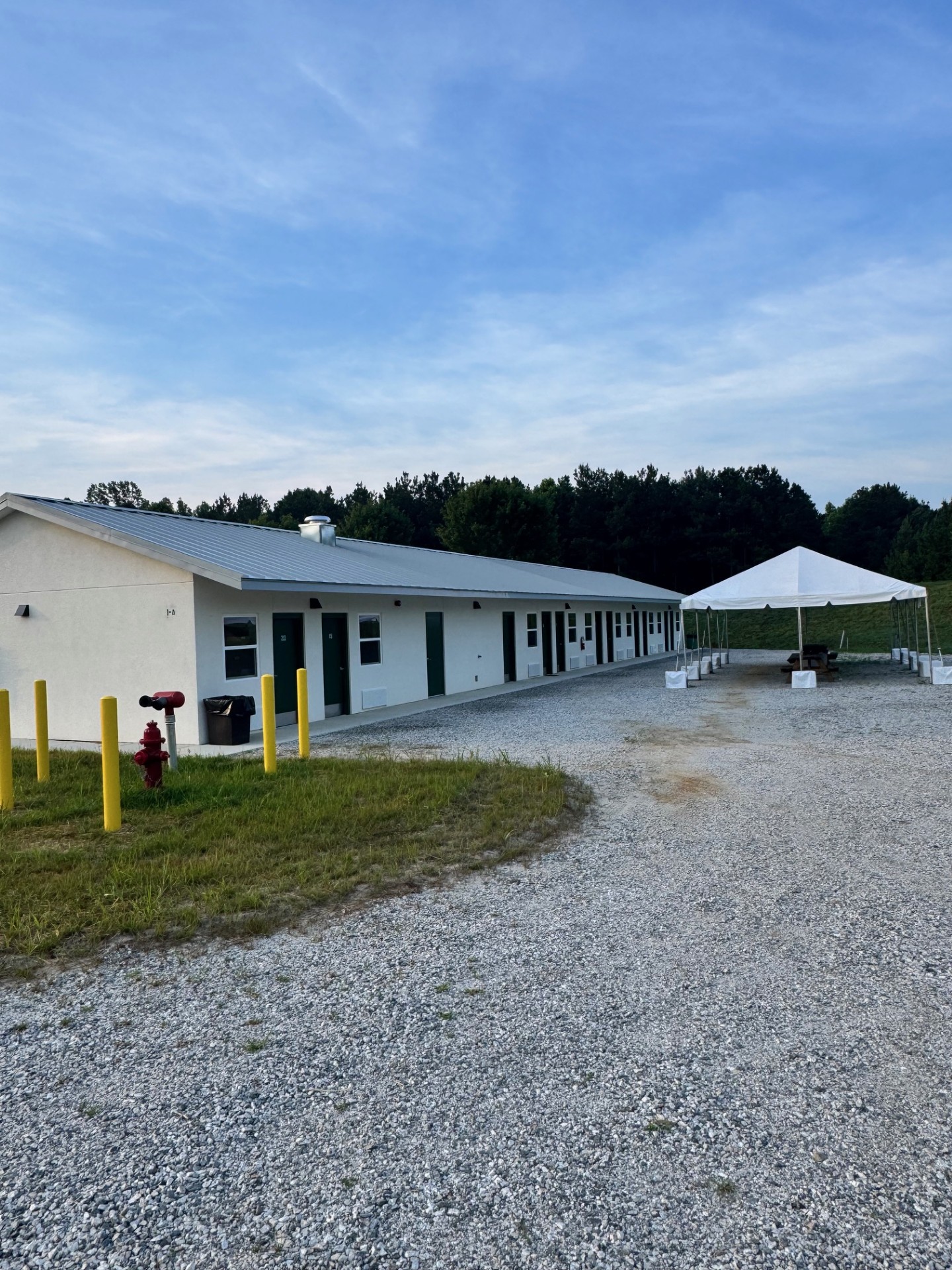
A new $1.9 million dormitory will debut which provides additional space for grooms — which in turn has helped attract more trainers. Additional investments were made in turf course irrigation equipment, plus 5,000 cubic yards of material were applied to the dirt track. Colonial also hired Ron Smith, who has 50 years of experience working on tracks, to serve as a seasonal dirt track superintendent to complement Director of Track Operations Leif Dickenson.
From a racing standpoint, a minimum of eight races are expected to be carded on weekdays and a minimum of nine on Saturdays. Stakes races will be carded every Saturday during the meet including six total for Maryland/Virginia-bred/sired horses at $125,000 each, six $100,000 stakes/handicaps for Virginia-restricted horses, and four $125,000 stakes for Virginia-bred/sired horses. Any weather-related cancellations will be made up on Sunday afternoon of that same week.
The Virginia Thoroughbred Association (VTA) is riding a wave of momentum as the state’s horse racing scene continues to grow, triggered by the success of Historical Horse Racing wagering handle at seven different Rosie’s Gaming Emporiums spread across the Commonwealth. That success has led to 44 days of racing at Colonial Downs in 2025, up from 27 race days a year ago — including a new 3-day meet in March highlighted by the running of the Virginia Derby and Oaks as new qualifying races for the Kentucky Derby and Oaks. A $5.8 million summer stakes calendar and record purse distribution of $27 million highlight the summer campaign.
The VTA’s incentive programs are growing in conjunction with purses and handle, and now is an ideal time for breeders, owners and trainers to discover the benefits of these initiatives. Whether it’s the Virginia-Bred, Virginia-Certified or Virginia-Sired program, potential bonus monies await.
The Virginia-Bred program offers rewards to breeders, developers and owners of registered thoroughbreds foaled in Virginia. Breeders earn bonuses for finishing first, second or third in any open race in North America, outside of state-bred and state-sired races. Breeders’ bonuses are earned for any top three finish at Colonial Downs and at NSA sanctioned meets. In 2024, bonus payouts turned out to be 36% of purses earned making this program’s return on investment the only one of its kind in the country. In order to qualify, the foal’s dam must reside in Virginia from September 1st of the year of conception until foaling the following year.
Amy Moore is a commercial breeder based in Northern Virginia and is a VTA past president. “Being a commercial breeder, I sell most of the foals I produce as weanlings or yearlings, and they might go anywhere to race. Lots of Virginia-breds run in New York or the mid-Atlantic, where they are eligible for purse enhancements, lucrative restricted races, and bonus money. But if my Virginia-bred foals run well against open company in Florida, or Kentucky, or California, or even in Canada, I earn breeder’s incentive awards there as well.”
“Many breeders’ programs offer incentives for state-bred horses to run in their home state against other state-bred horses,” added Moore. “Virginia has some great restricted-race opportunities at Colonial Downs, but it also rewards breeders who produce horses that can compete against anyone, anywhere. The national reach of Virginia’s program is a real benefit to Virginia breeders.”
Virginia-bred awards also extend to the developer and owner as well. The developer, who is the owner of the horse when it makes its first lifetime start, earns up to a 25% bonus for open race wins in six states — New York, New Jersey, Pennsylvania, Delaware, Maryland and Virginia — including NSA sanctioned meets in the Mid-Atlantic. Developer awards are not earned for out-of-state wins during Colonial’s meet and only for open race wins at Colonial Downs.
Owners of Virginia-breds earn a 50% bonus on 1st thru 4th place winnings in open races at the New Kent track. At Colonial Downs, Virginia-bred horses are also eligible to compete in Virginia-Restricted 2-Year-Old Stakes, Virgnia-Restricted Handicaps, Virginia-Bred/Sired Stakes and Maryland/Virginia-Bred/Sired Stakes— courtesy of a new slate of events to be contested at both Colonial and in Maryland. In addition, Virginia-restricted overnight purses are 25% higher than open race purses (at Colonial).
“Virginia’s award pool is large, and growing,” said Moore. “Breeding thoroughbreds is expensive, and that bonus money certainly helps to pay the bills. I love the flexibility of Virginia’s incentive program. There is no breed-back rule and no requirement to breed your mare to a regional stallion. If you buy a mare at public auction, she can qualify for the program if you bring her to Virginia within 15 days. I bought a nice mare at the Fasig-Tipton sale last November and brought her to Virginia, and she foaled a Virginia-bred Flightline colt this spring. I am excited to see what he can do in a few years’ time!”
The formation of Virginia’s Certified-Residency program back in 2016 helped stabilize the native industry after Colonial Downs’ initial owner surrendered the track’s racing license in early 2015. From 2016 – 2023, over $16 million in bonus monies have been distributed to graduates of the residency program. In order to qualify, horses must reside at a Virginia registered farm for at least six consecutive months before December 31st of their two-year-old year. Developers then earn up to a 25% bonus for any open race win in the states noted in the Breeder’s section above, and a 10% bonus for state-bred restricted races in those same states, with the exception of Virginia.
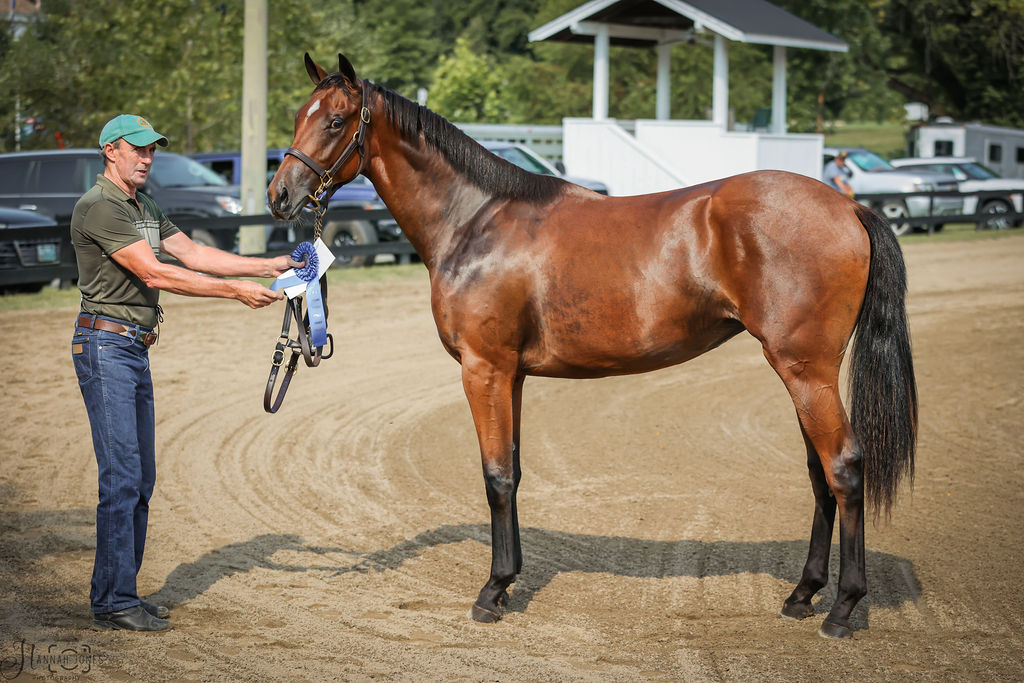
“It’s an interesting program because Virginia is a great place to raise young horses,” said Wayne Chatfield-Taylor who along with his wife Susie, have owned Morgan’s Ford Farm in Front Royal, VA since 1979. “The way to qualify a baby for the program is to get them here (to Virginia) early for the minimum six month stay but even afterwards, they have to be boarded somewhere, so why not stay here. Virginia has a nice environment, has four seasons and has really good pasture. Developers will get bonus money once the horse starts racing and the horses will reap the benefits of good farmland. It’s a win-win.”
Owners should note that Virginia-Certified horses are eligible to compete in Virginia-Restricted races at Colonial — with Virginia-Bred & Virginia-Sired horses. The Virginia-Restricted summer lineup includes two $100,000 freshmen stakes and four $100,000 Handicap races.
The Virginia-Sired program is open to thoroughbreds conceived in Virginia, sired by a Virginia-registered stallion, and foaled out of state. Developer bonuses mirror those noted in the Breeders and Certified program sections. Owners earn a 50% bonus on 1st thru 4th purses in open races at Colonial and experience the same overnight and stakes purse bumps as noted in the Breeders section.
“The VTA is excited to see this kind of growth and momentum in the industry as challenges arise across the nation,” said VTA President Turner Kobayashi. “The Certified program and the Owner and Breeder purse bonus awards have attracted more mares producing more foals and more horses racing in the state and locally. We hosted the Virginia Derby in March this year as a prep race for the Kentucky Derby. We continue to look at ways to innovate and improve to attract more owners, breeders and fans to experience the thrill that thoroughbred horse racing brings.”
The Belmont Racing Festival was nothing short of impressive during the five-day meet at Saratoga. The Kentucky Derby winner Sovereignty (Into Mischief) versus Preakness winner Journalism (Curlin) face off was the talk of the week. These two colts would give the large crowd a thrill as they battled down the Saratoga stretch with Sovereignty once again getting the better of his rival, and Baeza coming on late for the show spot. History was made with the same 1, 2, 3 order of finish as the Kentucky Derby. What a race to remember!
Throughout the week at Saratoga, Virginia had its own Stakes presence represented by a few Virginia-certified horses. Starting the week on June 4th was Bernietakescharge (Take Charge Indy) in the Critical Eye Stakes (Black Type) race. The four-year-old mare, certified at Rofe Racing in Middleburg, Virginia, “took charge” of the race straight from the gate. Bred and owned by Robert Rosenthal and Bradford Bernstein, they found themselves in the winner’s circle celebrating another success from their multiple stakes winning mare.
On Thursday’s card you could catch Future Is Now (Great Notion) in the Intercontinental Stakes Gr. 2. The 2024 Virginia-Certified Filly Champion, certified at Legacy Farm in Bluemont, Virginia, won the 2024 edition of the Intercontinental as part of her remarkable season. She was the favorite at post time this year, and though being unsettled in the gate, she broke well. Jockey Paco Lopez guided Future Is Now to the inside of Pipsy (Kodiac (GB)) for a head-to-head stretch battle and despite a gallant run by the five-year-old mare, she came up just short of winning, settling for second to Pipsy and jockey Jose Ortiz. Bred by R. Larry Johnson and owned by The Estate of R. Larry Johnson, her 2025 debut came at Keeneland winning the Giant’s Causeway Stakes Gr. 3. The Virginia Thoroughbred Association looks forward to seeing what this Trombetta trainee has in store this summer.
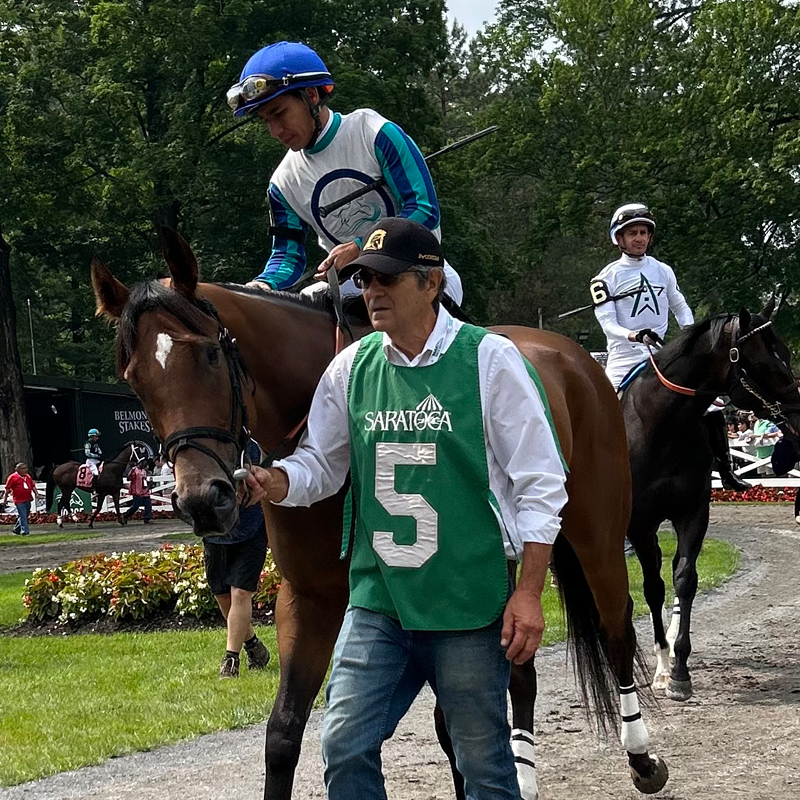
Future Is Now and jockey Paco Lopez in the paddock
2024 Virginia-Certified champion, Book’em Danno got his chance to shine as one of the favorites in the G-3 True North on the Belmont Stakes day undercard. The four-year-old Bucchero gelding was in a perfect position under jockey Paco Lopez and made his move on the turn, challenging the favorite Mullikin (Violence) down the stretch. It was incredible to watch Book’em Danno from the stands pulling ahead of his competition. There was no doubt he had the win in the bag. Bred by Gregory Kilka & Bright View Farm, owned by Atlantic Six Racing and trained throughout his career by Derek Ryan, Book’em Danno was Virginia Certified by Gracie Bloodstock in Middleburg. The Virginia Thoroughbred Association looks forward to cheering on these connections.
Book’em Danno and jockey Paco Lopez are led out of the paddock by co-owner Mark Rubenstein
Though Mother Nature’s relentless storms caused an adjusted schedule of the under tack shows and the sale days, the Midtlantic 2-Year-Olds in training sale still set record highs for gross, average and median sales.
After 326 horses sold in the ring during a marathon session on Tuesday, May 20th, the record setting gross came to $44,192,500. The sale was seen as “a sale to remember,” for many reasons. Four horses sold for $1+ million; the first time this sale has ever seen more than one horse sell for a million dollars.
Among the 586 horses listed in the catalogue, 26 of them were registered with the Virginia Thoroughbred Association. The Virginia-certified horses, which are appealing to buyers due to the lucrative incentive programs available, sold for an average of $86,500. Hip 208, a chestnut filly by Practical Joke out of Kitten Empress, was the highest selling Virginia-certified horse going to trainer Norm Casse for $285,000. This filly was certified at Timbercreek Farm under the care of Sara and Zach Miller in Charlottesville, Virginia. During the preview she breezed in :10.3.
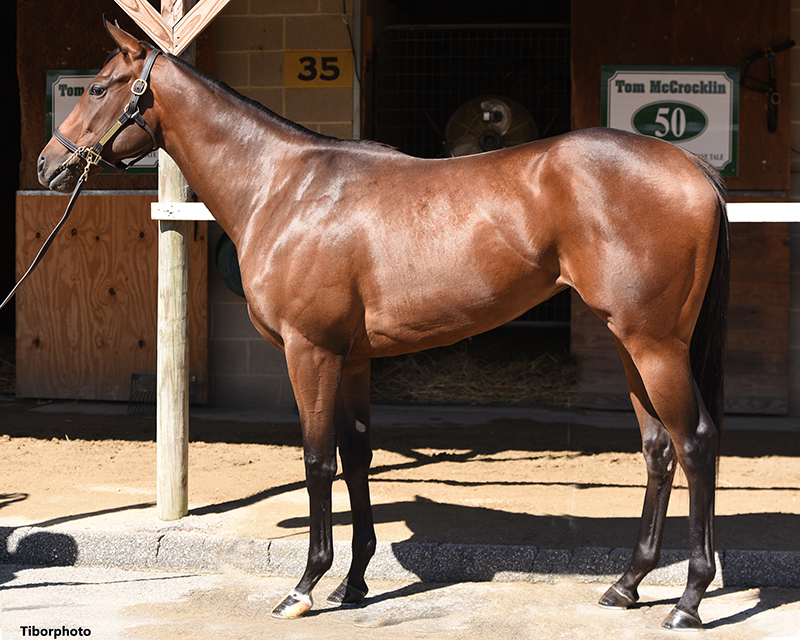
Hip 510 was the second highest selling Virginia-certified horse going to Augustus Mcrae for $180,000. This 2-year-old dark bay colt by Vekoma out of Yalisha was certified at Ballyerin Racing, LLC with Madison Meyers and Kieron Norris in Middleburg, Virginia.
Hip 510 (Vekoma – Yalisha, by Run Production). Tibor Photography.
The Virginia-breeding program continues to grow as horsemen throughout the country see the additional lucrative benefits associated with owning and racing a Virginia-bred.
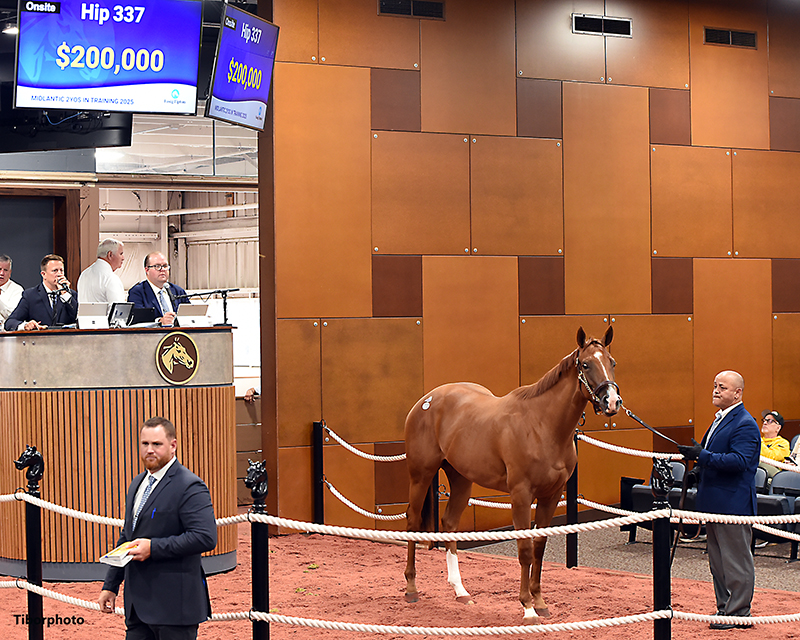
The highest selling 2-year-old Virginia-bred was Hip 337. The chestnut filly by Vekoma out of Rachel’s Smokin sold for $200,000 to Colts Neck Stables. The 2-year-old was bred by Gerard Lopez.
Hip 337 (Vekoma – Rachel’s Smokin, by Sky Mesa). Tibor Photography.
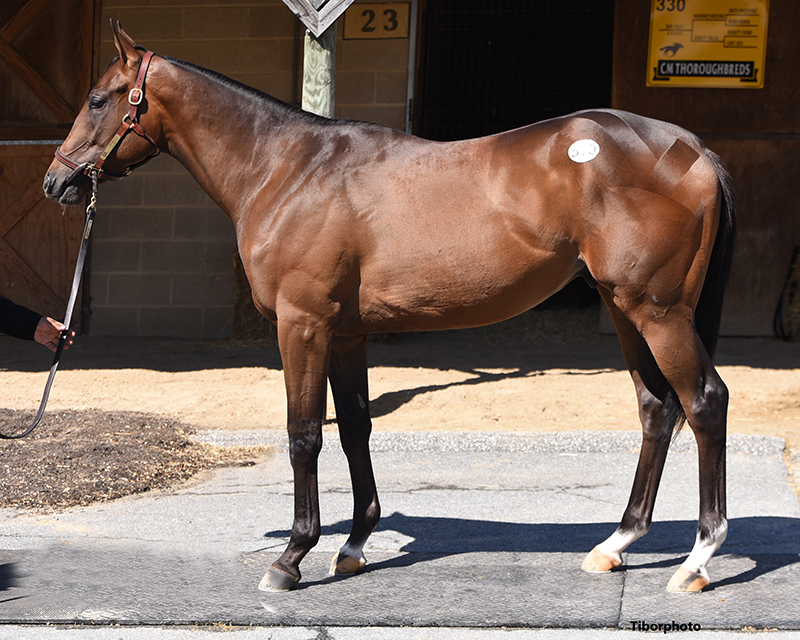
The second highest selling Virginia-bred in the sale sold for $150,000 to Huburt Guy Bloodstock. Hip 65, a bay filly by Charlatan out of Compensate, was bred by Virginia native Ann Mudge Backer/Smitten Farm.
Hip 65 (Charlatan – Compensate, by Liam’s Map). Tibor Photography.
The Fasig-Tipton Mid Atlantic two year old sale was a solid success for Virginia-bred and certified horses further showing the value and benefits of these growing programs. For more information go to www.vabred.org.
Turner Kobayashi, President of the VTA, put it best saying, “…We received a lot of airtime, press and social media coverage that always helps expand our mission. Great crowd and fun. The hospitality was second to none and made our guests feel special and welcomed.” Full Article
2024 VTA Champions Awards
2024 VTA Champions Awards Between races the VTA held their annual Champions Awards presenting the award recipients for 2024. It was the perfect day to thank and honor our Virginia horses, breeders, and trainers in front of a record crowd. Hunter Marek, representing Smitten Farm and Mrs. Anne Backer for Gigante’s 2024 achievements, stating, “It was absolutely perfect…the food was delicious, the company was great, and the racing couldn’t have been better! It feels good being a VTA member and seeing how far racing in Virginia has come in the last few years.” Full Article
Virginia Harness Horse Association
Construction work is well underway on a new $1.5 million barn project at the Shenandoah County fairgrounds in Woodstock, VA – home of Shenandoah Downs – that will accommodate up to 140 horses during harness meets beginning later this year. The structure will provide a safe environment for standardbred horses that reside in the track’s backstretch.
Upcoming Events
Virginia Horsemen’s Benevolent & Protective Association
The condition book, stakes schedule, and stall applications for the 2025 summer meet at Colonial Downs in New Kent, VA, are now available online at Colonialdowns.com. Stall applications are due Friday, May 7, 2025. The backside opens to horsemen on Monday, June 23rd. The first day of training is Wednesday, June 25th.
Virginia Gold Cup · May 3, 2025
Join us for the 100th running of the Virginia Gold Cup races at Great Meadow! The VTA/VHBPA tent will be located on Members Hill. Food services open at noon and drinks are a cash-only bar. Tent reservations are open to VTA and VHBPA members for $50 per person. The owner’s tent will also be combined with our tent. Owners who have a horse(s) entered that day will receive credentials from the Gold Cup office for free admission to the tent. Reservations are open through April 24th or until the event is sold out!
2025 Spring Harness Racing
Celebrate 10 years of harness racing at Shenandoah Downs this spring and fall. Conveniently located at the Shenandoah County fairgrounds (I-81, Exit 283) there is racing every Saturday and Sunday with Pari-mutual wagering on all races.
With the conclusion of the first spring meet in Virginia, we are looking forward to Colonial Downs’ 41-day summer meet July 9 – September 13.
Race days are as follows:
Wednesdays-Saturdays July 9- September 13
Saturday, August 9th Festival of Racing
Monday, September 1st (Labor Day)
Saturday, September 6th GIII Old Dominion Derby / Old Dominion Oaks
Reminders: Horse Owners, Breeders, and Participating Facilities
Virginia-Certified Program · 2023 Foals
Do you have a Thoroughbred who was foaled out-of-state and looking to bring it to Virginia? As a reminder, horses in our Virginia-certified program must arrive and complete 6 consecutive months (180 days) before December 31st of their 2-year-old year. All 2023 foals must arrive at a Virginia participating facility by June 30th to complete the program. Applications and applicable fees are due within 30 days of arrival.
Reminder to all Virginia Participating Facilities
Horses may move from your facility to another as long as the second facility is registered with the VTA. In these cases, we still need verification forms from every facility with the dates the horse(s) was at your farm.